

Il Duomo di Pescia
In the peculiar urban layout of Pescia, built with two distinct nuclei on the two banks of the river—one developing longitudinally, the other with a circular pattern—the Parish Church of S. Maria (Pieve di S. Maria) constituted the hub of the settlement on the left bank of the Pescia river. The houses and streets surrounding it, built around it, determined a circular structure for this very reason.
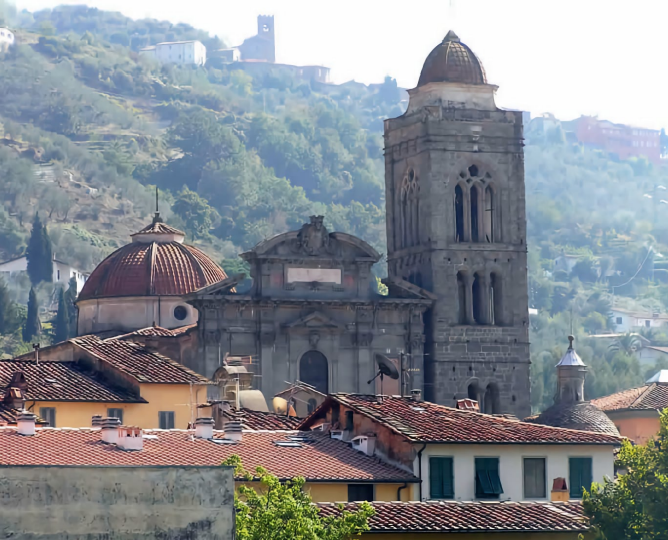
The facade, which remained unfinished until the end of the nineteenth century, was built by Giuseppe Castellucci from Arezzo according to neoclassical modules and was completed in 1933 with the insertion of the sumptuous marble portal. Leaning against the Gothic bell tower, it is divided into two overlapping bands by a cornice supported by Corinthian pilasters and half-columns. The upper band features, in the center, an arched window with
a balustrade, and is topped by an elaborate pediment.
L’imponente architettura novecentesca del Duomo di Pescia nasconde l’origine medievale dell’edificio. La prima chiesa risale al IX secolo e subisce sostanziali rifacimenti già nel Duecento. La Pieve faceva parte del sistema di pievi attestate sul confine orientale della Diocesi di Lucca e manteneva vincoli di comunione e legami gerarchici con il proprio vescovo. Un decisivo mutamento si ebbe quando, nel 1519, su istanza di Baldassarre Turini, un prelato devoto ai Medici, papa Leone X emananò la bolla pontificia istitutiva della Propositura nullius diocesis, cioè non dipendente da alcuna Diocesi ma direttamente dalla Santa Sede. Di fatto sanciva la gravitazione del pesciatino nell’orbita fiorentina. Con la realizzazione della cappella Turini, si costituiva un primo passo nell’ aggiornamento dello spazio ecclesiale cui si andarono a sommare, dopo gli anni ‘60-’70 del 1500, a seguito del Concilio di Trento, una sostanziale trasformazione dell’edificio ecclesiastico. (Ampliamento e maggior fruizione dell’aula e del presbiterio, sistemazione del coro dietro l’altare maggiore, moltiplicazione di altari e cappelle).
Some eighteenth-century memoirs, though unconfirmed by documents, hand down that on October 18, 1671, the ancient parish church collapsed, and it was then that the Chapter of the Prelature ordered the new temple to be built. It is highly probable that the fall of the ancient medieval church was desired by the powerful Chapter of the provostry, which saw the construction of a new and larger church as a symbol of its
dominance over the Church of Valdinievole. A historiographical tradition informs us that the architect who oversaw the work was Antonio Ferri; however, new research has led to the thought of another figure, Tommaso Ramignani from Pistoia.
Unfortunately, it took many years to rebuild the church; in 1696 the dome was finally finished, but for two more centuries it remained with a bare brick facade, where one could still admire, in the lower part, indicative remains of the ancient parish church.
Testifying to the medieval age are the blind arches located on the outer sides of the church and the beautiful marble lectern placed on the presbytery. This is a unique group, formed by various components of the ancient pulpit of the parish church and dating back to the 13th century.
Testifying to the medieval age are the blind arches located on the outer sides of the church and the beautiful marble lectern placed on the presbytery. This is a unique group, formed by various components of the ancient pulpit of the parish church and dating back to the 13th century.
-
Interior
The Cathedral, inside, shows an elegant and severe architecture: three chapels on each side overlook the wide nave covered by a sail vault. Important cornices, capitals, and pillars (pilasters) mark a harmonious, solemn environment; beautiful paintings, finally, adorn the multi-colored marble tabernacles. The building of the Cathedral church is full of particular traditions and stories and is, in its own way, the cultural mirror of the city.
On the right, just after entering, we can see the marble plaque of the parish priest Rustico who died in 1132. In the upper part is the splendid plaque, equally made of inlaid marble, which commemorates the provost Lorenzo Mancini, ordinary of this church from December 15, 1704, to March 7, 1707.
-The first Chapel, built by the Petruzzi family and later passed to the Raffaellis, preserves the nineteenth-century canvas by Luigi Norfini, and in a niche on the left is the bust of Giovanni Pacini, a famous composer who spent the last years of his life in Pescia.
-The next chapel, once under the patronage of the Flori family, one of the most illustrious in the city, linked to the Duchy of Mantua, features a beautiful 1698 painting by Marcant’Antonio Donzelli of Mantua. It depicts St. Charles Borromeo administering the Holy Viaticum to plague victims; above, an angel sheathes a sword to signify the end of the scourge. An inscription under the altar table recalls that the patron, Francesco Flori, was a member of the aforementioned family. In the right and left lunettes are placed two statues by Quirino Coli, depicting St. Jerome
on the right and St. Joseph with the flowering staff on the left.
The third chapel, which local tradition claims was designed by Ferdinando Fuga, belonged to the Forti family, who also owned the beautiful palace located in the Ruga degli Orlandi. The Fortis are the only local family to count among their members a bishop of the Pescia see, Msgr. Pietro Forti, who held this office from 1847 to 1854. The bishop is, therefore, portrayed in a half-bust
in a lunette placed on the left wall of the Chapel.
The pleasant and elegant painting on the altar, with cold and enameled colors, is by Giuseppe Bottani, a painter from Cremona. The iconographic theme is the birth of the Madonna. In the background are St. Joachim and, on the opposite side, St. Anne lying on the bed.
On the left wall, in an urn, is a beautiful painted copy of the Madonna Salus Populi Romani that Canon Domenico Cherubini had brought from Rome on the occasion of the 1650 jubilee.
After observing the 1766 pulpit located on the right pillar of the central arch, you enter the transept area to admire the beautiful Chapel of the Blessed Sacrament, also known as the Turini chapel. The most well-known member of the family was Msgr. Baldassarre, who worked in Rome as a datary for Popes Leo X and Clement VII. The peculiar mausoleum of the great Baldassarre was executed by Raffaello di Bartolomeo Sinibaldi, known as da Montelupo, while the marble portrait of the prelate is the work of Pierino da Vinci, Leonardo's nephew.
Before 1516, Baldassarre Turini purchased from the Florentine Dei family Raphael's unfinished panel, featuring the Madonna enthroned and saints, known as the Madonna del Baldacchino (Madonna of the Canopy), which represents both a form of art patronage and the cult of family memory. This remained in the chapel until 1697, when it was purchased by Prince Ferdinando de' Medici. The sale by the heirs was not accepted
kindly by the people of Pescia, who considered it "stolen", so much so that it was transported to Florence at night to avoid riots.
Turini's singular position originated various local traditions. The nicest legend reports that the upright position of the bust is due to the "miraculous awakening" from the death of the "Papal Datary," right at the moment when the Raphael painting was removed from the Pescia provostry, by order of Prince Ferdinando.
The return of the original, now at the Uffizi, to what was its first location is scheduled for spring, along with the copy by Dandini currently undergoing restoration in Lucca.
In the floor, at the center of the chapel, is the tomb of Monsignor Angelo Simonetti, Bishop of Pescia from 1908 to 1950. This important place was reserved for the prelate for having governed the diocese with loving zeal for a full 42 years. The people of Pescia, in fact, are very attached to the memory of this figure who was very close to the population during the Second World War. His portrait is located in the last chapel on the left.
Presbytery
In the floor of the presbytery area is the sundial commissioned by the Bishop of Pescia Donato Maria Arcangeli (1742-1772), today entirely visible following the restoration work. An eighteenth-century wooden choir furnishes the apse space; the capitular stalls were built in the nineteenth century, while those of the chaplains date back to the 1930s.
In the center of the apse, set in a beautiful marble frame, is the large painting by Luigi Garzi from Pistoia representing the Assumption of the Virgin, which immediately draws the visitor's attention upon entering the church.
On the left, the large late 18th-century wooden bishop's throne was replaced during the recent restoration by a new throne made of marble and glass tesserae, which, rotated 90 degrees, faces the faithful.
The cathedra, the altar, and the ambo that unites the elements of the medieval pulpit are part of the same intervention that gave a new, brighter, more harmonious, and functional face to the liturgical needs of the building.
The chaplains' sacristy room is furnished with admirable fifteenth-century benches. On the first two doors of the right counter, you can admire the coats of arms of Pope Pius II Piccolomini, who granted their use to Cardinal Jacopo Ammannati. (The cross with the 5 moons of the Piccolomini is surmounted by the cardinal's hat). Ecclesiastical tradition has it that this furniture was commissioned to Giovanni da Montichiello in 1476.
Instead, the second sacristy, that of the canons of the cathedral, is furnished with benches from 1650. The room was built around 1646 to a design by Pantaleone Quadri from Pistoia; designed at the behest of the Chapter, the capitular sacristy exhibits important paintings. On the left is the portrait of Msgr. Giovanni Ricci, a work by Bartolomeo Orsi; in the center, above the seventeenth-century counter that kept the chaplains' maces,
is a beautiful painting by Pompeo Caccini representing St. Peter's miraculous catch of fish. On the left is the portrait of Msgr. Turini, also attributed to the painter Bartolomeo Orsi.
On the entrance door of the sacristies is a beautiful painting representing the Martyrdom of St. Lawrence, a work from the late sixteenth century. The stoup located near the door, with the putto holding the basin, is a 17th-century work.
Opposite the sacristy is the door that once led to the Library stairs: in fact, the inscription "Bibliotheca Capituli" is engraved on the architrave.
Between the two doors, in the middle of the left transept, the glazed terracotta triptych by Luca and Andrea della Robbia: Madonna with Child and Angels between St. James and St. Blaise (15th century) was moved into the cathedral from the episcopal sacristy in 2020 after the recent restoration. It is a work of great importance because it is one of the first examples of the use of this technique in the Della Robbia school. The placement in the center of the transept refers to an ideal dialogue with the copy of Raphael's painting, in the center of the opposite transept.
Curiosity: the tips of the feet and the shell of St. James are missing.
The restoration with the new placement of the triptych, wanted by our bishop Msgr. Roberto Filippini, was sponsored by the cultural association "Quelli con Pescia nel Cuore".
Returning to the great nave, on the right as you face the main door of the church, there are equally three chapels:
The first, dedicated to St. Lawrence, was under the patronage of the Cecchi family. Attributed to the prestigious hand of Andrea Pozzo, it features on the altar the magnificent canvas by Anton Domenico Gabbiani, while on the sides are placed the mural tombs, with corbelled sarcophagi and busts, of Stefano and Giovan Battista Cecchi, both provost canons of Pescia in the seventeenth century. The canvas adorning the upper vault is also by Anton Domenico
Gabbiani.
The second chapel, dedicated to Our Lady of the Holy Rosary, as it was the religious seat of the Company of the Rosary, was built at the end of the seventeenth century, while the altar was built in the early years of the following century, when the large canvas by Antonio Franchi from Villa Basilica was placed in the aedicule. This presents a peculiar pictorial conformation, because in the lower part, behind the figure of
the beautiful angel with the Rosary, one can glimpse a valley that resembles the Valdinievole; above, behind the Madonna who hands the Rosary to St. Dominic, are depicted St. Dorothy, patron saint of Pescia, and St. Catherine of Alexandria, patron saint of papermakers. (Once the third chapel was dedicated to St. Allucio, with a canvas by Romano Stefanelli, executed in 1985, now in the adjacent oratory, closed to the public. There you can find the beautiful sixteenth-century crucifix that the canons of the Cathedral displayed in the liturgical functions of Good Friday. In the nave of the chapel, as well as under the high altar, there are two stone remains from the parish church of S. Maria di Pescia. It is supposed that these two 13th-14th century sculptures were part of the fixed furnishings of the facade and were located in the upper space of the entrance doors).
-The third chapel is the seat of the Baptistery. In the chapel is the sixteenth-century baptismal font, above which is the painting attributed to Alessandro Bardelli.
-On the sides of the entrance door are the two beautiful Renaissance stoups donated by the Cecchi family. On one of the two was the beautiful little St. John (San Giovannino) now in the capitular museum.
The bell tower, characterized by the large opening on the ground floor, is perhaps of early medieval origin; it was rebuilt in the fourteenth century and in 1776 the "bizarre" small dome was created by the then bishop Donato Maria Arcangeli. This incongruous covering and the traditional beautiful tolling of the bell (one hour after sunset and one before sunrise, which marked the opening of the gates and indicated the direction of the city to any lost travelers) are particularly dear to the people of Pescia.
Passing through the arch of the bell tower, you enter the cloister of the Bishop's Palace. Rebuilt in different eras, the palace of the Bishops of Pescia is characterized by the roof terrace (altana) that, in the second half of the eighteenth century, Msgr. Arcangeli used as an astronomical observatory.
Curated by the Association "Quelli con Pescia nel Cuore"