

Oratory of Sant’Antonio Abate
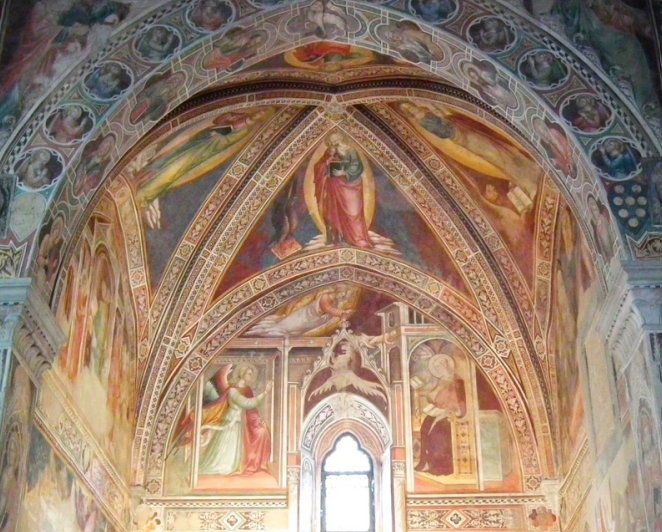
Founded in the second half of the 14th century by the Antonian order, it was incorporated into the hospital of Saints Cosmas and Damian in 1775. It is characterized by a simple square stone facade. The interior, with a Latin cross plan and a single nave, is covered by a wooden truss roof and ends with a frescoed rectangular apse.
Of notable interest is the wooden group depicting the Deposition of Christ in the left transept (12th century). In the right transept is preserved the Crucifixion of Jesus between Saint Anthony the Abbot and Saint Paul the Hermit, a work by Alessandro Bardelli (first half of the 17th century). Of significant interest is the pictorial decoration of the triumphal arch and the presbytery area, executed by Bicci di Lorenzo between 1421 and 1436.
The fresco is in direct line with the fifteenth-century liturgical aspect and represents the summa of the life of Saint Anthony the Abbot on the sides of the small altar.
The chapel measures 3.80 x 3.60 meters and can accommodate only the officiant and a few presbyters, from which it can be deduced that the frescoes were not conceived for the faithful.
Following a clockwise direction, we encounter as the opening scene of the story "The Revelation", which is divided into two episodes: the revelation (Gospel) and the giving of alms to the poor. Then we see the young Saint deeply struck by the words spoken by the priest, indicating the possible choice for man of a spiritual life. Having entered the Christian Kingdom, Anthony gives charity to the poor. He donates his wealth, as the evangelist Matthew says, and is now pervaded by spiritual light, recognizing his future life in
the poor. The young man, dressed in a red garment, gives money to the poor, to an old man and a child holding hands. Behind them are a man and a woman who do not receive money, but witness the event. The woman could be the Saint's sister, who, upon the death of their parents, was entrusted to a female convent, so Anthony gave her the money in the form of a dowry.
The temptation at the gates of the Castle in the valley of the Pescia river.
From left to right, the Saint is seen speaking with a black child, while in the second part the struggle against the tempting devils unfolds. The Saint, turning his head, catches sight of that disturbing figure, suggesting sordid thoughts; he repels them with prayer. High above appears Pescia, divided into two urban sectors: the tower and the castle, both walled, and the bell tower of the ancient parish church, today the cathedral. Connecting the sectors are two bridges crossing the river, that watercourse originating from
steep mountains above the San Francesco bridge.
The satanic tumult is near the river and between the two bridges, but, holding the Christian truth, a small church rises on the top right with a fountain in the churchyard from which water flows.
The struggle is fierce; one can see the evil green figure placed in the center, then the monster with a human body and a wolf's head, a snake with fiery eyes and a trifurcated tongue.
The temptation, therefore, is the image of Anthony's victory over the evil one, the stone on which the Christian virtues of the patriarch against the Devil are completed and fortified.
The first scene on the left has as its theme the embrace between Anthony and Paul the First Hermit. Anthony, coming from a cursed place, after facing a long journey, meets Paul who is emerging from a cave covered in a rough habit made of plant fabric. At the top, we see a satyr pointing the way to Paul's hermitage.
On the right side of the front wall, we can see at the top the hand of God, a black raven, and a palm tree under which the two Fathers consume the broken bread, symbol of the Eucharist.
The burial of Paul the First Hermit.
The scene develops following an established pattern: Paul lying on the ground with Anthony at his feet, attempting to place the body in the hole dug by the lions, who came to the Saint's aid. In the upper part, Paul's soul in glory observes his burial. Anthony holds a Tau-shaped staff (the last letter of the Hebrew alphabet), a symbol of the regular canons.
In the lower area of the right wall, in contrast to that of the temptation, there is the great representation of the burial of Saint Anthony with the participation of the clergy, with clerics and high prelates gathered around the Patriarch's coffin.
Curated by the Association "Quelli con Pescia nel Cuore"