

Oratory of Madonna di Pie’ di Piazza
The oratory was founded in 1447 by order of the Pescia nobleman Francesco Galeotti, Notary of the Auditor of the Apostolic Chamber in Rome, who dedicated it to Saints Peter and Paul. The Renaissance-style architecture is perhaps one of the most important examples of Brunelleschi's influence in the Valdinievole. The design of the façades is in fact attributed to Andrea di Lazzaro Cavalcanti da Buggiano, a pupil and adopted son of Filippo Brunelleschi.
The interior of the oratory features a richly inlaid wooden ceiling by Giovanni Reti, known as Giovannone dei Crocifissi, from Pistoia, designed by Maestro Domenico Marcacci, also from Pistoia. The Virgin Mary is placed in the center, flanked by Saints Peter and Paul. The sculptures were painted and gilded by Ippolito Brunetti for the sum of 300 gold florins.
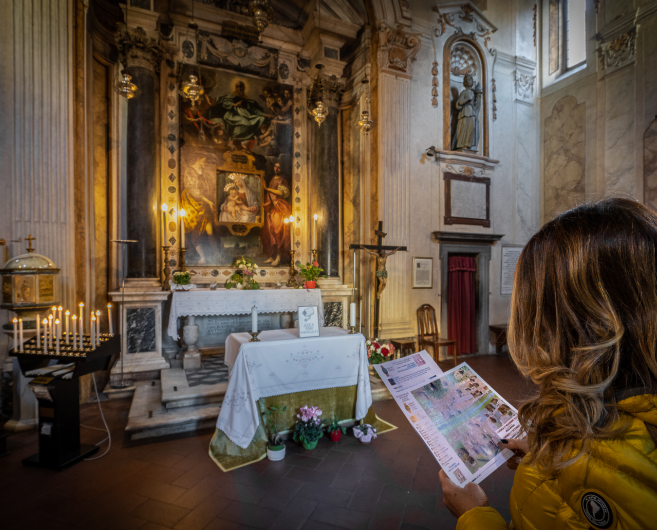
On 1 January 1605, this oratory gave a worthy and permanent home to the image of the Madonna delle Grazie (fresco on slate), which for more than two centuries had been placed in a shrine on the Ponte della Pieve (of the Cathedral).
Since it was considered miraculous, the faithful had left numerous testimonies of graces received there, such as paintings, little hearts, candles, and stuccoes, so much so that the small building could not contain any more.
To further enhance its splendor and decorum, the Chapter of the Provostship and the Municipality decided, partly due to the lack of space at the shrine, to move the image to a more suitable location. Initially, they considered building a new small church, but then, lacking the financial resources, it was decided to move the Madonna to the Oratory of Saints Peter and Paul. The Grand Duke's permission came along with authorization to spend 140 scudi for this extraordinary event.
It was January 1, 1605 when the people, brotherhoods, religious orders, Priors and Captains of the Municipality and the Royal Vicar Giovanni Berti took part in the procession of the Madonna made more grandiose and imposing by several squadrons of halberdiers forming part of the guard of honor of the Grand Duke Ferdinand III, Princess Cristina of Lorraine and their son Cosimo, who had come from Florence to perform an act of devotion.
The citizens competed in decorating the streets and lighting them. The bells of the city and surrounding towns rang continuously. Pescia had never seen such a popular turnout.
Before placing it on the altar, Monsignor Stefano Cecchi gave his blessing to the crowd from the door of the oratory with the prodigious image.
To further demonstrate his devotion to the Madonna, the Grand Duke wanted a marble altar with the Medici coat of arms placed in place of the stone altar. However, this was never built; in its place was placed the family coat of arms. The painting of the decorative panel was entrusted to the Bolognese Alessandro Tiarini, who depicted the Eternal Father in glory at the top, angels at the sides, and, at the bottom, a view of the city of Pescia, including the Ponte della Pieve, the small shrine, and the bell tower of the church.
.
The devotion to the Madonna was such that people from various regions of Italy came to Pescia bringing offerings of various kinds.
The feast dedicated to the Madonna, known as the Piè di Piazza, is celebrated on May 6th of each year, as on that day in 1605 it was “shown to be most miraculous”.
Next to the altar is a precious marble slab from the Holy Door of the Vatican Basilica (Holy Year 1650), donated by Pope Innocent X to the Pescia priest Domenico Cherubini. The organ dates back to the 18th century.
The Sacred Image was crowned in 1937, but two foreign thieves, ignoring the cameras, stole the gold ornament; a silver one was recently placed in its place.
Curated by the Association "Quelli con Pescia nel Cuore"