

San Francesco Church in Pescia
Curated by the Association "Quelli con Pescia nel Cuore"
“Struck by divine Grace, after having exchanged the belt and spurs of the elegant knight for the rope and sandals of the hermit, having crossed the flourishing Valdinievole, at the beginning of October 1211, Francis of Assisi arrived in Pescia—a humble servant and follower of Christ—to implement here, as elsewhere, a peaceful and silent revolution, in the bold attempt to restore Christian customs to the purity of their origins.” (L. Wadding, Annales Minorum).
Tradition holds that Saint Francis, before continuing toward Pisa—where he had Blessed Agnello degli Agnelli and Blessed Alberto as disciples—stopped in Pescia in October 1211 for three days. He was the welcomed guest of the wealthy and pious merchant Venanzio degli Orlandi, who gifted him a small oratory and a small hut so that he might establish a convent for his friars.
The Saint, preceded by his reputation as a peacemaker, arrived in Pescia at a time when the city, like others, was troubled by discord between communes, violence, and internal and external conflicts. Accepting the gift from Count Venanzio degli Orlandi, he sent for two friars from Florence to care for the oratory, to which an infirmary was likely attached.
The small church, "separated from the mainland by the length of a bridge over the Pescia river," was located in the northern part of the city in a place called “Giocatoio”. The construction of the “San Francesco Bridge”, as it came to be known (later destroyed by retreating German forces in September 1944), became necessary because the small Franciscan settlement on the opposite bank was increasingly becoming a pole of spiritual and charitable attraction.
-
The oratory mentioned today forms part of the current church and was situated between the Chapel of the Conception and the Chapel of the “Corda Pia” (or Cardini Chapel). This small oratory was expanded almost immediately by Venanzio Orlandi himself when Gregory IX raised Saint Francis to the glory of the altars. Many Pesciatine families, such as the Obizzi, Mainardi, and Torrigiani, contributed to its realization.
-
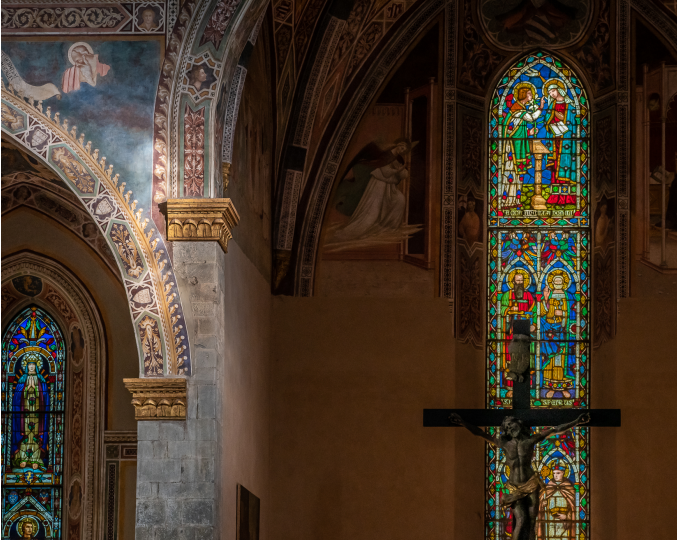
Inside, the church, clearly of a Gothic-inspired style, displays many works of art; its floor plan is a Latin cross, and the transept is marked by the presence of two stone altars and splendid paintings. The first chapel on the left was built between around 1453 and 1458 by the will of the brothers Antonio and Giovanni Cardini; the design of the original furnishings is attributed to Filippo Brunelleschi, while the execution was carried out by Andrea di Lazzaro Cavalcanti, called il Buggiano, a pupil and adopted son of the master.
“At the center, beyond the beautiful five-legged porphyry altar table, stands a 15th-century crucifix in the Florentine style, linked to the work of Giuliano da Maiano (Maiano 1432–Naples 1490), while the coloring of the figure was done by Neri di Bicci. On the back wall is a fresco from 1458, also by Neri di Bicci, which depicts the patrons in prayer, with a dolphin and a horse’s head above them, heraldic symbols of Pescia and Colle Val d’Elsa respectively, the latter being the city of origin of the Cardini family.
-
“The coats of arms of Pescia, the Dolphin, and the Cardini, the two crossed thistles (found on the front of the outer arch and on the second step of the altar) are called ‘speaking’ arms, as they refer to the name of the city and the family. It is noteworthy that in heraldry the dolphin is considered a fish, so Pescia chose the most noble ‘fish’…
The altar references Masaccio’s ‘Trinity’ painted in Santa Maria Novella in Florence.
The second chapel is called the Chapel of the Immaculate Conception (16th century), today dedicated to the fallen of the First World War. There, highly valued works are displayed, such as the 14th-century statue of the Virgin with Child, which on April 13, 1506, the day before Easter, was said to have performed miraculous signs that urged people to live more virtuous lives, marked by penance and charity towards others. On April 20 of the same year, the Company of Mercy was established, whose mission was to assist the sick, to keep vigil and pray with those condemned to death on the night before their execution, as well as to clothe and bury the deceased.”
The same chapel houses a copy by Alessandro Bardelli illustrating a Pietà by Ludovico Cardi, known as il Cigoli. Also by Bardelli is the cover that once closed the panel of Saint Francis by Buonaventura Berlinghieri.
The most famous artwork in the Franciscan church is precisely the panel by the Lucchese artist Bonaventura Berlinghieri, depicting Saint Francis with six stories on the sides. The painting, dated 1235, has been restored multiple times; it was fully rediscovered in the mid-19th century. Since it was created nine years after the Saint’s death, it is assumed that the artist knew him in life. It should be noted that this is the oldest and most well-known depiction in the world of the Saint with the stigmata.
On the transept altars are displayed: on the right, the Chapel of Saint Charles Borromeo with the beautiful painting by Rodomonte di Pasquino Pieri, a pupil of Cortona; on the left, the chapel of the della Barba family, with an altar commissioned by Messer Pompeo della Barba, physician to Pope Pius IV, surrounded by a beautiful frame in pietra serena, featuring a 16th-century painting by Iacopo Ligozzi depicting the martyrdom of Saint Dorothea (the city’s patron saint).
- The selection of the Saint took place in 1339, when Pescia, having endured from its very founding the oppressive and overbearing attention of Lucca, of whose territory it was part, and later of other Lordships, came under Florentine rule. Since this new voluntary submission was formalized on Saturday, February 6, it was decided to give thanks for its intervention to the heavenly entity commemorated on that day in the liturgical calendar: Saint Dorothea.
Saint Dorothea of Cappadocia, 279–311 AD, was asked to offer sacrifices to the gods and, unlike her sisters Christa and Callista, who had apostatized, she refused because of her Christian faith, and was condemned to death by beheading. On the way to her martyrdom, she met a man named Theophilus, who ironically asked her to send him apples and roses from her Lord’s garden. This was miraculously done by a child who appeared with a basket during her prayer before the beheading.
Theophilus converted to Christianity and subsequently suffered the same fate as Dorothea.
A relic of the Saint, brought to Pescia in 1561, is kept in Santo Stefano. Under the altar table, one can see a 16th-century fresco of the dead Christ, probably by the same Ligozzi.”**
Near the altar, placed vertically, are the tombstones of some members of the Obizzi family of Pescia, who, with the arrival of the Florentines in 1339, chose exile because they belonged to the Ghibelline faction.
The three chapels are decorated with frescoes; on the altar of the Chapel of Saint Anne is the well-known triptych by Nanni di Jacopo from Pistoia (15th century), depicting Saint Anne enthroned among Saints Simon, Thaddeus, Lawrence, and Dominic (third in hierarchy after the Child and His Mother).
-
In the central chapel, under the patronage of the Obizzi family, remnants of frescoes by Antonio Vite (1388) are visible, as well as the 17th-century painting of the Miracle of the Mule by Antonio Martinelli. The Nucci Chapel is adorned with early 15th-century frescoes from the school of Lorenzo di Bicci; in the central part, the Dormition of the Virgin is visible. The bell tower was erected between 1718 and 1719, based on a design by Carlo A. Arrighi. The pointed arch separating the transept from the nave features 14th-century frescoes, attributable to the artists who worked in the transept chapels; it continues the same decorations found above those chapels.
On the opposite side is the Serponti Altar, from the 16th century, with the large painting of Saint Charles Borromeo in prayer by Rodomonte Pieri and Francesco Nardi (1642).
In the nearby sacristy is preserved the fresco of the Crucifixion by Antonio Vite, dating to the late 14th century.
-
On the left wall is the Deposition by il Passignano (1595), previously in the Church of the Misericordia; on the right, the Martyrdom of Saint Bartholomew by Giovanni Imbert (1760). To the left, a small door opens onto the Stiavelli Chapel, which houses an 18th-century Saint Francis, featuring a particular view of Pescia.
“The main chapel, called the Obizzi Chapel, was restored in the 1930s when the frescoes by Antonio Vite, dating to around 1388, were discovered, depicting the Evangelists in the vault spandrels and fragments of a Massacre of the Innocents and other scenes. The right wall shows a painting from around 1632, the Miracle of the Mule by Giovanni Martinelli, which tells how, after a discussion with a heretic from Rimini regarding the presence of Christ in the Eucharist, Saint Anthony presented the consecrated host to a mule, which knelt in adoration despite being hungry, with hay nearby. On the opposite side is a copy of a Bolognese painting entitled the Miracle of Saint Anthony of Padua, dating to the early 18th century.
-
-
**“The chapel to the right of the main altar belonged to the Nucci-Salutati family and features a cycle of frescoes by Bicci di Lorenzo from the early 15th century. They are dedicated to the life of Mary, with, at the center above the altar, the fragmentary Dormition, where the Madonna is shown lying during the ‘dormitio’ and Jesus behind her holding her ‘little soul,’ depicted as a child. The vivid colors and richness of detail reflect the late Gothic culture. In the vault’s spandrels, the Evangelists are depicted.
The stories are completed by the episode of the Coronation, placed outside the chapel, above the arch.
There are two curiosities on the exterior of the church: on the pietra serena pilaster on the right as you enter, the inscription ‘1608 l’olmi’ recalls how, in that year, the friars cut down elms in front of the church, despite a ban imposed by the Municipality, which led to a legal dispute.
The second is a stone with the inscription ‘refecta,’ which commemorates how in 1567 the façade and part of the interior of the church were rebuilt.
Curated by the Association "Quelli con Pescia nel Cuore"